Duration
June 2023 – March 2024
Transforming manual validation into an automated, low-code engineering workflow.
I designed the tool that let automation engineers stop validating plant logic by hand — and trust an automated result instead, in an environment where a wrong pass reaches a real plant.
June 2023 – March 2024
75% shorter test cycles
20+ customers since launch
2024E15630 IN
Automation engineering in process industries is complex and changes constantly. Guaranteeing correctness means repeatedly testing control logic, interlocks and sequences — and that work was manual, done under time pressure, often before real hardware was available.
Four costs compounded: high effort per cycle, real risk of human error, limited test coverage, and mounting frustration with re-testing after every engineering change. Errors that escaped early testing surfaced later in the plant lifecycle, where they cost far more to fix.
Engineers validated logic by hand because the stakes were physical. Asking them to delegate that to a tool meant the tool had to make its reasoning legible — what ran, what passed, what failed, and why.
Zero-latency coupling with simulation and DCS ruled out a web application. I designed a Windows app, but deliberately built the visual language to web conventions so a future web transition would not mean starting over.
A single coupling can expose millions of signals. Any interaction that worked at forty signals and broke at ten million was not a real solution.
A series of workshops with automation engineers working on simulation engineering, plus discussions with SMEs, produced the requirement set directly.
The tool had to access systems under test — SIMATIC PCS 7, SIMATIC PCS neo, TIA Portal — over OPC UA, trigger user inputs and errors, and validate correct engineering behaviour.
The interaction model was first validated in an earlier SIMIT training-simulation tool, where stakeholder response proved the approach before it was adapted here.
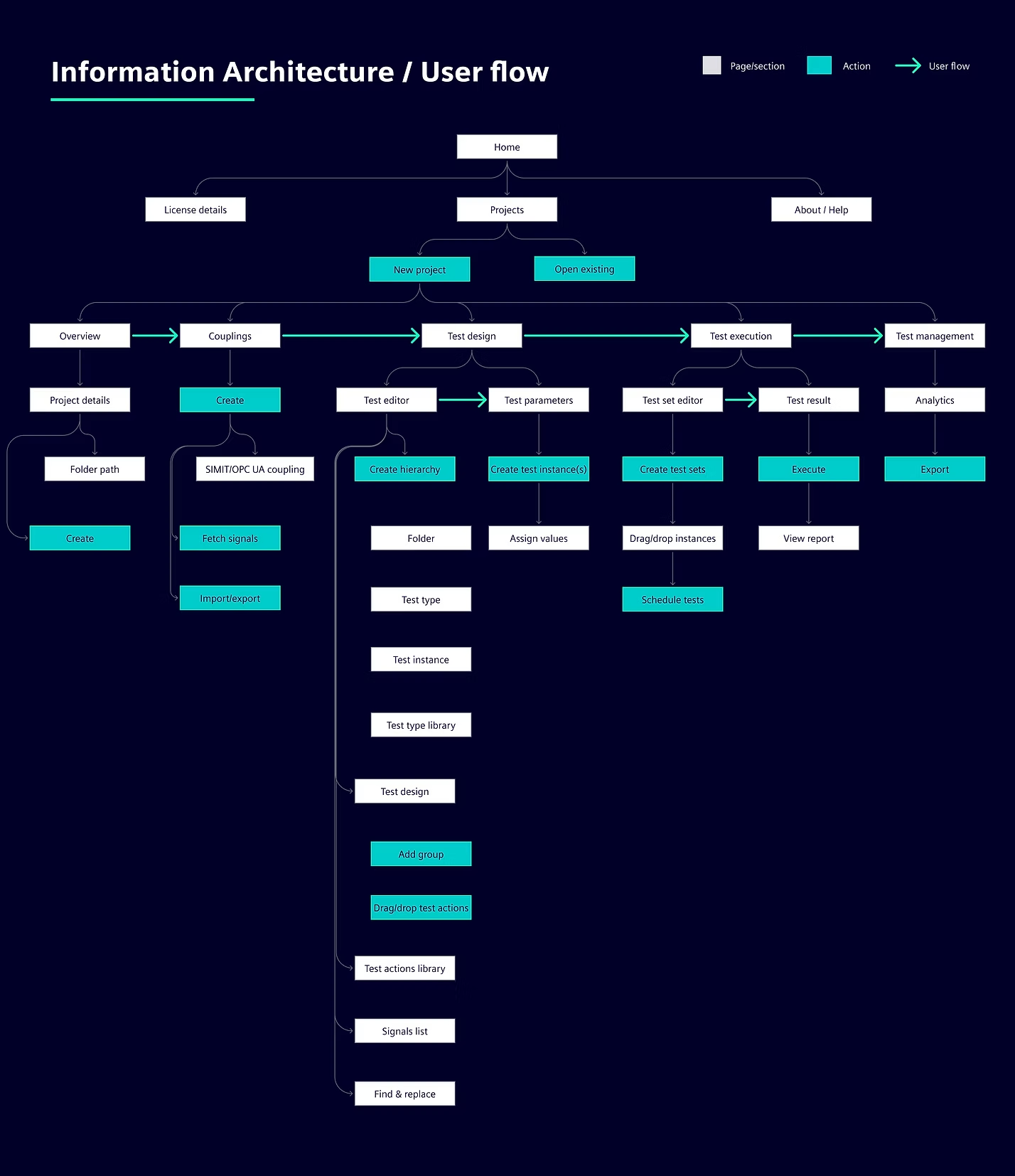
When a verification fails mid-run, the right response depends entirely on context — sometimes the run should continue, sometimes everything downstream is invalid. Choosing on the engineer's behalf would be wrong either way.
Every Verify action carries an explicit 'if verification fails' choice — Continue, Break group, Break instance, or Break test set — paired with an Important flag per action so engineers mark which assertions actually matter and filter results by that judgement.
The engineer's expertise stays in control of the automation instead of being overridden by it.

The tool has a mandatory sequence — connect couplings, fetch signals, design test types, create instances, build test sets, execute — and a wrong start produced confusing dead ends.
Every empty state names its prerequisite rather than just reporting emptiness, guiding users to create couplings before viewing signals, and to add a test type before designing test actions.
The sequence becomes learnable without training material, answering 'what now?' at the moment the question arises.
Renaming a signal across a large project is essential but risky — a careless global replace silently corrupts a validation suite across millions of signals.
Find & Replace shows a result count first, then a confirmation dialog with a scoped tree where engineers select exactly which folders and test types to change and see a live count before committing, followed by a success confirmation linked to a replacement log.
Preview, scope, confirm, audit — a destructive operation made recoverable in practice.
A pass/fail verdict alone doesn't build trust; engineers need to see what the tool actually did.
Results expand step by step with each action's description, execution comment, importance flag and outcome, and connection attempts are logged as first-class results so an environment failure is never mistaken for a logic failure.
Engineers can audit the automation rather than take it on faith — the precondition for handing over work they previously did by hand.
Complex programming made test-sequence creation inaccessible to broader engineering teams.
A visual workflow builder and drag-and-drop interface supported rapid scenario creation.
Automation testing became accessible to broader engineering teams.
Validation needed to run in an automated testing environment while keeping results understandable.
Integrated validation logic with intelligent error detection and diagnostic recommendations.
The framework provided simple result interpretation within the automated testing environment.
Engineering teams needed both an overview and detail when reviewing test information.
Interactive dashboards supported movement between overview and detail.
The analytics surfaced optimisation and efficiency opportunities.
Testing depended on live systems despite complex industrial scenarios.
A virtual environment supported automation testing without live system dependencies.
Testing could use realistic conditions matched to real environments.
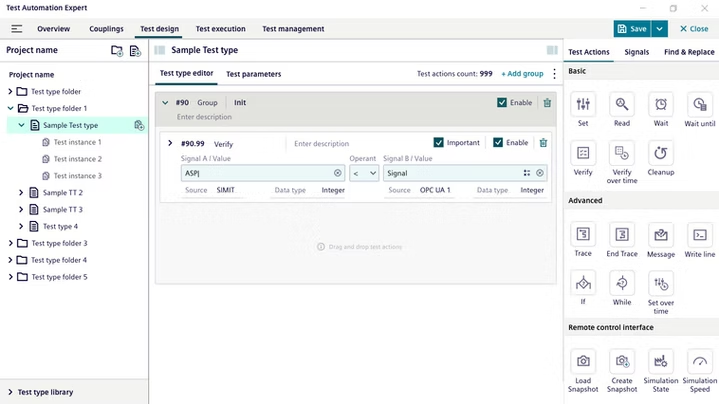
The interaction model here did not start with this product. It was first proven in an earlier SIMIT training-simulation tool, where stakeholder response validated the approach. Rapid Tester was the tighter, faster-to-ship application of it — and the one that reached market first. Designing something once and having it become the vocabulary for a second product is the part of this work I would carry forward.